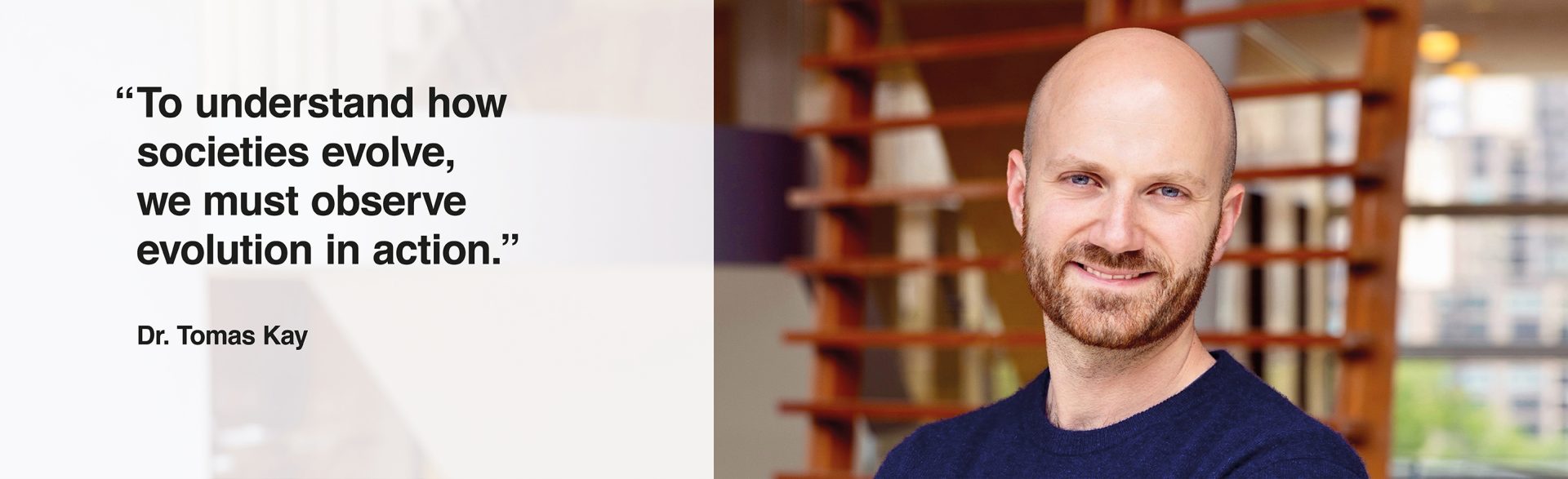
Branco Weiss Fellow Since
2026
Research Category
Evolutionary biology, social evolution, behavioral ecology, neurogenetics
Research Location
The Rockefeller University
Background
How do complex societies evolve through countless small changes in behavior, genetics and social interactions? Tomas Kay addresses this question using ants, whose colonies function as highly organized societies with division of labor, communication networks and collective decision-making. Although biologists have developed powerful experimental approaches to study evolution in microbes, comparable methods have rarely been applied to multicellular animals. Kay’s research exploits the unusual biology of the clonal raider ant, a species whose workers reproduce clonally and can therefore be combined into experimentally controlled societies. By tracking how different genetic lineages cooperate, compete and spread through colonies, he aims to reveal the evolutionary forces that shape social behavior. Integrating automated behavioral analysis, genomics, neurobiology and genetic engineering, his work will provide an unprecedented opportunity to observe social evolution directly and to identify general principles that govern the emergence of cooperation across animal societies, including our own.
Details of Research
Tomas Kay’s project will use the clonal raider ant Ooceraea biroi to study how cooperation and competition influence the evolution of animal societies. Because this species has no queens and reproduces clonally, genetically distinct lineages can be combined in experimentally controlled colonies. Kay will track which lineages outcompete others, under which ecological conditions, and through which behavioral traits. He will then examine the molecular and neural mechanisms behind these traits using sequencing, optogenetics and genetic engineering. The long-term aim is to recreate social evolutionary processes experimentally in a multicellular animal system.